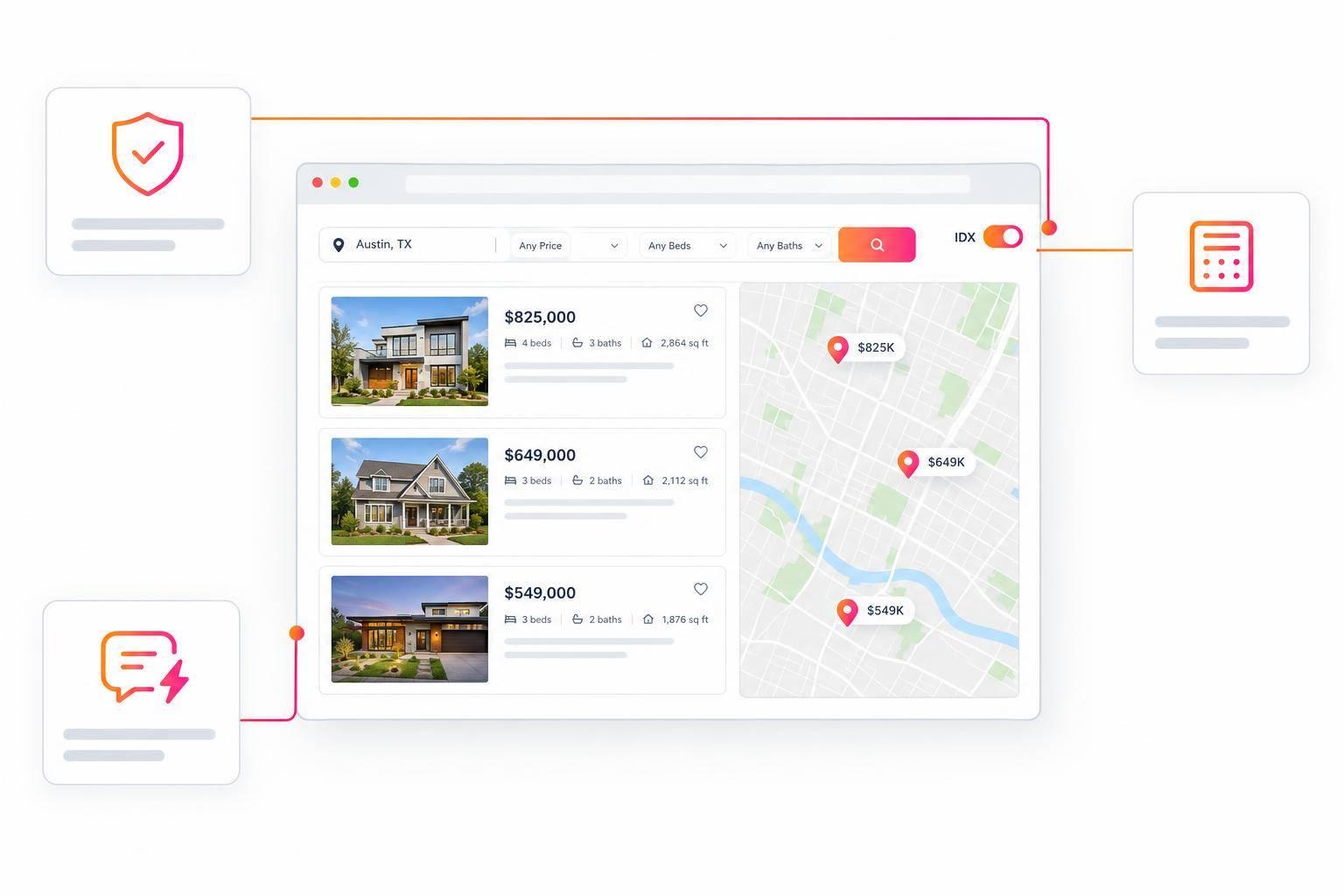
Your real estate website needs IDX only if visitors want MLS property search and your team can handle the leads, costs, and rules. Before buying, confirm MLS eligibility, get an itemized quote, and assign someone to follow up on inquiries.
There are 3 options: an IDX website for buyer search, a non-IDX website for seller services and consultations, or a hybrid that offers both. The right choice depends on visitor needs - not the number of features.
Quick Comparison
| Website model | Best fit | Lead tools | Costs and upkeep | Compliance |
|---|---|---|---|---|
| IDX | Buyer-focused agents and brokerages | Property inquiries, saved searches, alerts | Feed fees, search tools, CRM connections, and maintenance | MLS approval, listing display rules, and feed updates |
| Non-IDX | Listing-focused and referral businesses | Home valuation forms and consultation requests | No IDX fees; website and content upkeep still apply | Advertising rules, photo rights, and listing permissions |
| Hybrid | Businesses serving buyers and sellers | Search tools plus seller inquiry forms | Website costs plus IDX fees and separate lead routing | IDX rules still apply, even with limited search |
Searchable listings don’t guarantee business. Budget for staff time as well as subscriptions, then review qualified conversations and appointments after 60–90 days - not just traffic or registrations.
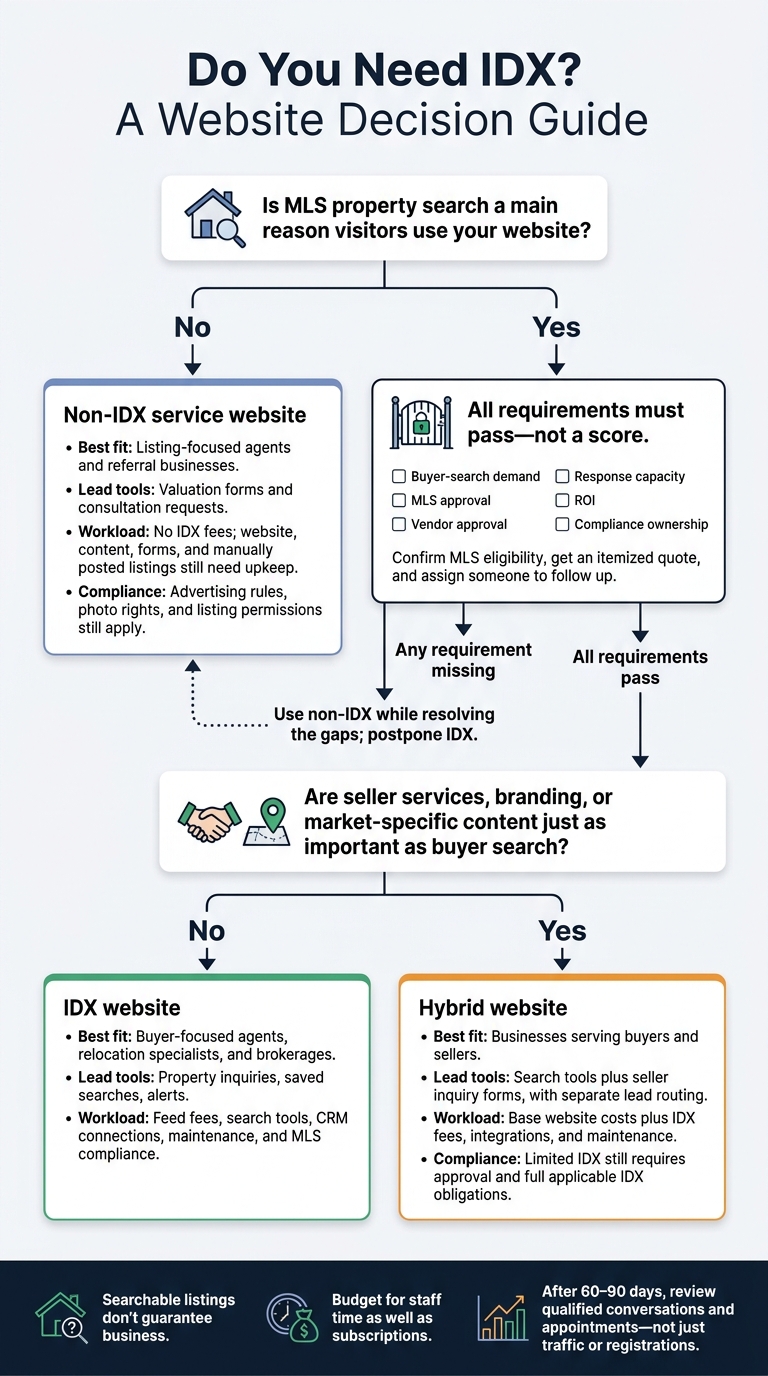
Do You Need IDX? A Website Decision Guide
What IDX Includes and Requires
Internet Data Exchange (IDX) is the MLS-approved system that lets participating brokers display eligible MLS listings from other brokerages. An approved data connection updates property information without manual page edits. Common features include search filters, listing pages, maps, saved searches, alerts, and inquiry forms. These tools help people find properties, return to the site, and contact the brokerage. Only MLS-approved fields may appear; showing instructions, security details, and other confidential information must stay private.
The MLS participant, usually the broker, controls eligibility. Affiliated agents generally need the participant’s permission. Before launch, confirm the required agreements, approved provider or feed method, and approval for each domain, subdomain, or app. The broker must control what appears, how it appears, and how the site identifies the brokerage. Hiring a provider does not transfer the broker’s compliance responsibility.
Local rules cover attribution, brokerage identification, disclosures, opt-outs, field access, and update timing. NAR’s published guidance calls for automatic updates at least every 12 hours, but your MLS may require more frequent updates. Regular updates don’t guarantee that every listing appears. Seller opt-outs, coverage gaps, and feed errors can leave listings out. Assign one person to check for outdated statuses, missing attribution, outages, and broken forms - even when IDX is only one part of the site.
A hybrid site can serve sellers with home valuation tools while keeping buyer-search tools. Custom content does not change MLS obligations on listing pages. Keep required attribution, separate custom content from MLS listings, and follow advertising and co-branding rules. Review privacy notices, lead-data handling, and consent for email or text follow-up across forms and integrations.
IDX supplies inventory - not guaranteed traffic, leads, or search rankings. Set success criteria first, such as qualified registrations, repeat visits, or booked consultations. Confirm who will handle technical updates and compliance corrections.
1. IDX Website
Inventory and Audience Fit
Choose IDX when property search is a main reason people visit your site. It’s a good fit for buyer-focused agents, relocation specialists, and multi-area brokerages.
Check coverage in every county you serve. Also confirm that your MLS allows the data fields and listing statuses your audience needs. Listing-focused agents can showcase their own properties, but that alone may not warrant a full search experience. IDX earns its place when it matches how visitors use your site.
Lead Capture and Follow-Up
Let visitors browse before asking them to register. Saving a search or getting listing alerts gives them a clear reason to share their contact details.
Send every inquiry to a CRM like Follow Up Boss, assign someone to handle it, and track which search actions lead to consultations. Decide who acknowledges each inquiry and who follows up personally. Without reliable follow-up, search activity can create more work without bringing in business.
Costs and Workload
Ask for an itemized quote covering setup, subscriptions, MLS fees, hosting, integrations, and maintenance. Include staff time for lead review and troubleshooting in your annual budget.
Test mobile search and inquiry routing before committing. Confirm who will fix failed alerts, slow searches, and CRM delivery problems.
MLS Eligibility and Compliance
Before purchasing, verify permissions for every brokerage office, team, domain, and MLS area you serve. Get the search-filtering rules in writing. NAR policy allows neutral filters such as location, price, and property type, but prohibits excluding listings based on brokerage, agent name, or compensation.
Label featured listings clearly, and don’t use search filters to hide competing inventory. IDX fits when your audience needs property search and your team can handle the rules. If search isn’t central to your business, a service-focused site may be a better choice.
2. Non-IDX Service Website
If visitors don’t primarily need a property search, focus the site on consultations and seller leads.
Inventory and Audience Fit
Choose non-IDX when your main goal is consultations, not searchable listings. This model suits listing-focused agents, referral-based practices, and boutique brokerages whose sites center on seller resources, neighborhood expertise, testimonials, and direct consultation requests.
Buyers won’t have a searchable MLS feed, so make it easy to request personalized property recommendations. The next step should be a consultation or valuation request - not a property search.
Lead Capture and Follow-Up
Give visitors one clear next step:
“Request a Home Valuation” or “Book a 15-Minute Consultation.”
For valuation requests, ask for the property address first, then contact details. Deliver the report and follow up with a pricing conversation.
Costs and Workload
Automated home valuation tools can start at $29 per month and don’t require IDX. You won’t need to synchronize an MLS feed or maintain a search interface. You’ll still need hosting, security, up-to-date content, and working forms. Review service pages and test inquiry forms at least quarterly.
MLS Eligibility and Compliance
Even without IDX, property pages still require brokerage disclosures, photo rights, listing permission, and compliance with advertising rules. There’s no MLS feed to maintain, but manually posted listings still need regular price and status checks.
3. Hybrid Website
A hybrid model offers a middle ground when neither a full IDX site nor a non-IDX site fits your needs.
Inventory and Audience Fit
A hybrid site adds limited IDX to a service-first website. It suits brokerages that need buyer search tools and pages that turn seller visits into inquiries.
Buyer-focused agents can add saved searches; listing-focused agents can keep the site service-first and add search only when buyer traffic justifies it.
Give search its own page rather than placing it on the homepage.
Lead Capture and Follow-Up
A hybrid works only if your team can quickly sort buyer and seller inquiries. Route each group separately in your CRM. Set response rules for property inquiries, saved-search signups, showing requests, market reports, and contact forms.
Send saved-search confirmations immediately, and follow up within one business day. Assign backup coverage so inquiries don’t go unanswered.
Costs and Workload
Limited IDX doesn’t automatically mean lower costs. Budget for your base website, IDX feed access, CRM integration, setup, and regular maintenance. Get written pricing from the MLS and provider, since costs vary by users and integrations.
To judge ROI, track search registrations, conversations, appointments, and transactions separately from service-page leads.
MLS Eligibility and Compliance
Limited IDX still requires approval before launch, visible brokerage identification, attribution, and the required feed update schedule. Assign one person to monitor the feed. The pros-and-cons comparison below puts these tradeoffs side by side.
Pros and Cons of Each Website Approach
Each model serves a different business need: buyer search, seller conversion, or both. Compare the options against your audience, budget, and ability to follow up.
| Approach | Advantages | Disadvantages | Strongest fit |
|---|---|---|---|
| IDX website | A larger pool of MLS listings, filters, and property details helps buyers research homes. Saved searches and inquiry tools give visitors ways to get in touch. | Recurring fees, setup, maintenance, and compliance duties. Some listings may be withheld from Internet display, so the site may not show every property available in the market. | Buyer-focused agents, relocation specialists, and brokerages with a reliable follow-up system. |
| Non-IDX service website | More control over branding, seller resources, testimonials, and consultation forms - with no IDX feed to manage. | Limited on-site property search. Selected property pages may need manual updates, and content, SEO, and advertising can still be costly. | Listing-focused agents, referral-based businesses, and niche specialists whose visitors want expertise rather than property search. |
| Hybrid website | Offers property research and seller consultations, with separate paths for each audience. | Requires more design, integration, and measurement work while keeping IDX obligations. It can cost the most to build and maintain. | Full-service agents, teams, and brokerages with meaningful buyer and seller demand. |
Judge each option by qualified conversations, appointments, and transactions - not registrations. Compare the total cost of ownership, not just the build price. Also account for the broker’s responsibility to define lead ownership, set permissions, control vendor access, and provide oversight.
Choose IDX, Non-IDX, or a Hybrid
Use the comparison above for a final yes-or-no decision.
Treat this as a pass/fail checklist - not a score. Buyer-search demand, MLS approval, vendor approval, response capacity, ROI, and compliance ownership must all be in place before launch.
If anything is missing, postpone IDX and use a non-IDX site while you resolve the issue. NAR policy does not guarantee local MLS eligibility.
If every requirement passes, choose the setup that fits your business model.
| Outcome | Deciding conditions | Recommended setup |
|---|---|---|
| Individual-agent IDX | Buyer search is central, eligibility is confirmed, and you can handle follow-up | EasyAgentIDX Starter for straightforward search; Pro when buyer retention, alerts, and automation matter |
| Brokerage IDX | All prerequisites pass, and multiple agents need shared inventory, routing, reporting, and administrative controls | Brokerage for routing, permissions, and team reporting |
| Hybrid | Buyer search matters, but seller capture, branding, or market-specific content matters just as much | Combine approved IDX with seller pages and home-value tools |
| Non-IDX | Visitor search demand is low, eligibility is unavailable, or follow-up and compliance ownership are missing | A service-focused website with listings, testimonials, market content, forms, scheduling, and seller-generation tools |
| Seller lead capture without IDX | Seller inquiries are the main goal | AHV for home-value forms and valuation funnels without public MLS search |
Before launch, get written MLS and broker approval, submit each domain or subdomain, document display rules, and test routing and analytics.
Assign one follow-up owner and one backup, and set a response-time standard before accepting leads. After 60–90 days, review qualified leads and appointments - not traffic alone.
FAQs
Can I add IDX later without rebuilding my website?
Yes. EasyAgentIDX adds search widgets, maps, and listing grids to your existing website through embedded script tags - no rebuild needed. It works with WordPress, Squarespace, Wix, Webflow, Framer, and custom-coded sites.
Before listings can appear on your site, you’ll need official approval from your local MLS board.
What happens to my IDX if I change brokerages?
Your existing IDX agreement is no longer valid when you change brokerages. It’s tied to your previous broker of record and their authorization with the local Multiple Listing Service (MLS).
Contact your new broker and MLS to submit a new application under your new broker’s credentials, transfer your IDX feed, and update your authorization records. These steps keep your website compliant and fully functional.
How do I calculate whether IDX is worth the cost?
Compare total annual costs with your lead-generation goals and the projected value of leads that convert.
First-year cost = (12 × monthly charges) + one-time setup fees + separately billed MLS pass-through fees + optional expenses.
For renewals, leave out one-time fees. Count only recurring charges and optional expenses.
Before committing, get a written 12-month quote that includes taxes and potential overage charges. Check that the projected value of converted leads justifies the cost.